Kraken Software Engineer, Rust, Blockchain Platform - X-Ray
We ran three fictional personas through JobJam's evaluation system for this Kraken blockchain platform engineering role. Dmitri Volkov (HFT systems engineer with Rust and part-time blockchain consulting) scored 82%. Yuki Tanaka (Go/Python platform engineer with strong infrastructure but no Rust or blockchain) scored 52%. Chioma Osei (TypeScript full-stack developer and crypto enthusiast) scored 28%. The personas are made up. The JD, the evaluator, the scores, and the analysis are real JobJam output.
Disclaimer: This analysis is not affiliated with or endorsed by Kraken. It's an independent evaluation of how JobJam's AI assesses candidate fit against publicly available job requirements.
The role
Kraken's Blockchain Platform team builds the infrastructure that every other engineering team depends on to interact with blockchain data. The role involves designing high-throughput Rust services that abstract away the complexity of 120+ different blockchain protocols, handling over 1.2 billion operations daily. This is systems engineering at scale where security, performance, and reliability are non-negotiable, and where the technical decisions you make directly impact the entire organization's ability to ship features.
What this role is actually testing
-
Production Rust mastery, not language familiarity. Three years of Rust development experience means you've hit the ownership system's edge cases, debugged memory safety issues in production, and know when to reach for unsafe blocks. Academic knowledge or side projects don't prepare you for the complexity of financial systems where a panic can cost millions.
-
Blockchain protocol depth, not crypto enthusiasm. Understanding how Bitcoin UTXO models differ from Ethereum's account-based system, how to parse different transaction formats, and how to handle chain reorganizations. Reading whitepapers and deploying smart contracts doesn't translate to building the infrastructure that processes raw blockchain data at scale.
-
Security-first system design, not security awareness. Designing access control systems where a single privilege escalation could compromise customer funds. This means threat modeling, understanding attack vectors specific to financial infrastructure, and building systems that fail safely rather than just logging errors.
-
Distributed systems debugging, not theoretical knowledge. When a service handling 50,000 transactions per second starts showing increased latency, you need to trace the issue across network boundaries, understand how Kafka partitioning affects ordering, and debug race conditions in concurrent Rust code. Textbook knowledge of CAP theorem doesn't help when production is down.
-
Cross-team platform thinking, not individual contributor execution. Building abstractions that 20+ engineering teams will depend on means understanding their diverse requirements, designing APIs that won't break when new blockchains are added, and creating documentation that reduces support burden rather than just describing what the code does.
Profile A. Dmitri Volkov, HFT systems engineer with blockchain consulting
Dmitri is a senior systems engineer at Optiver with 7 years of experience building high-frequency trading infrastructure in Rust and C++. He's been doing part-time blockchain consulting since 2022, building Ethereum data pipelines and node infrastructure. His background combines the performance requirements of financial systems with hands-on blockchain protocol experience.
 Dmitri's fit analysis showing 82% ATS score, 8/13 skills matched, Strong Match
82%. Strong Match. 8/13 skills matched.
 Dmitri's technical assessment highlighting his production Rust experience and blockchain infrastructure work
Dmitri's evaluation shows a strong match driven by his production Rust experience at scale and hands-on blockchain infrastructure work. The assessment recognizes that his HFT background translates directly to the performance and reliability requirements of processing 1.2 billion blockchain operations daily. His part-time consulting work demonstrates practical experience with the exact technical challenges Kraken faces: block ingestion, node management, and building abstractions over blockchain complexity. The security-first mindset from regulated trading environments aligns well with cryptocurrency exchange requirements.
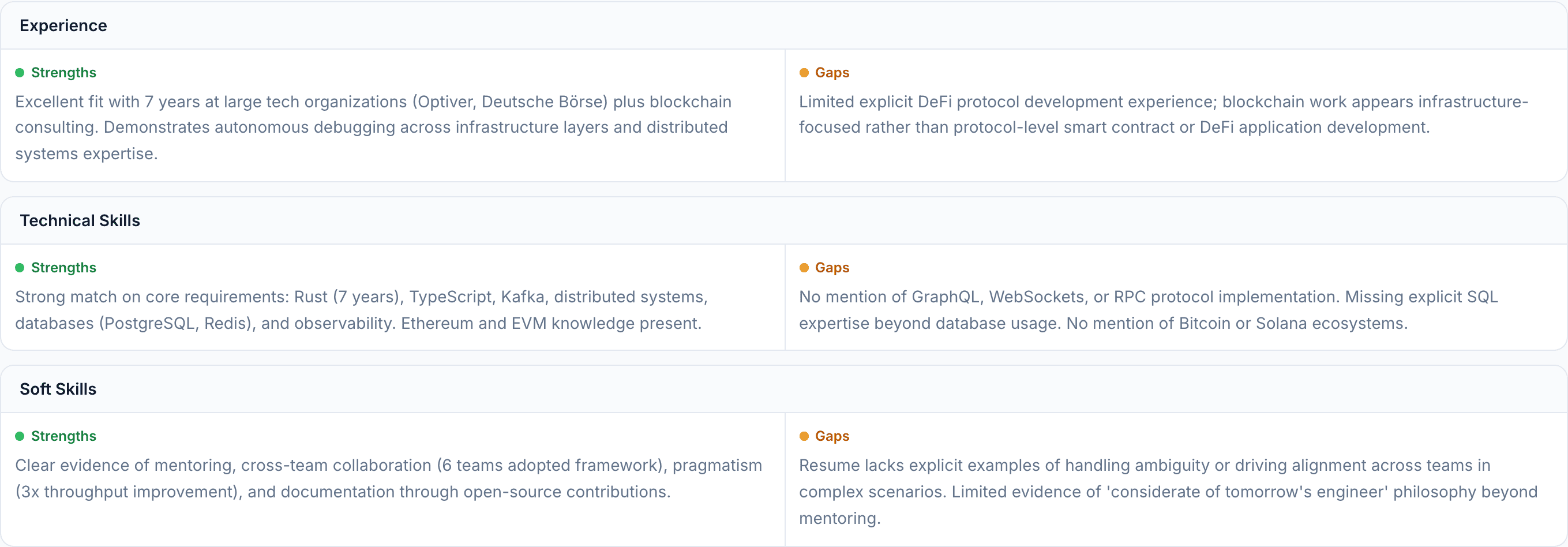 Detailed analysis of Dmitri's qualifications showing strong match for systems-level blockchain work
What JobJam recommended
-
Highlight DeFi protocol experience. Job emphasizes DeFi expertise as core requirement; current resume frames blockchain work as infrastructure-only, creating perception gap.
-
Add GraphQL and WebSocket examples. Both are listed as required skills but absent from resume; easy wins to demonstrate API design breadth.
-
Expand RPC and protocol knowledge. RPC protocols are core to blockchain infrastructure; current resume implies knowledge but doesn't demonstrate it explicitly.
-
Demonstrate Bitcoin or Solana exposure. Job lists Bitcoin, Ethereum, and Solana as deep knowledge areas; only Ethereum mentioned in resume.
-
Quantify security contributions. Security-first mindset is critical for blockchain; current examples focus on performance and reliability.
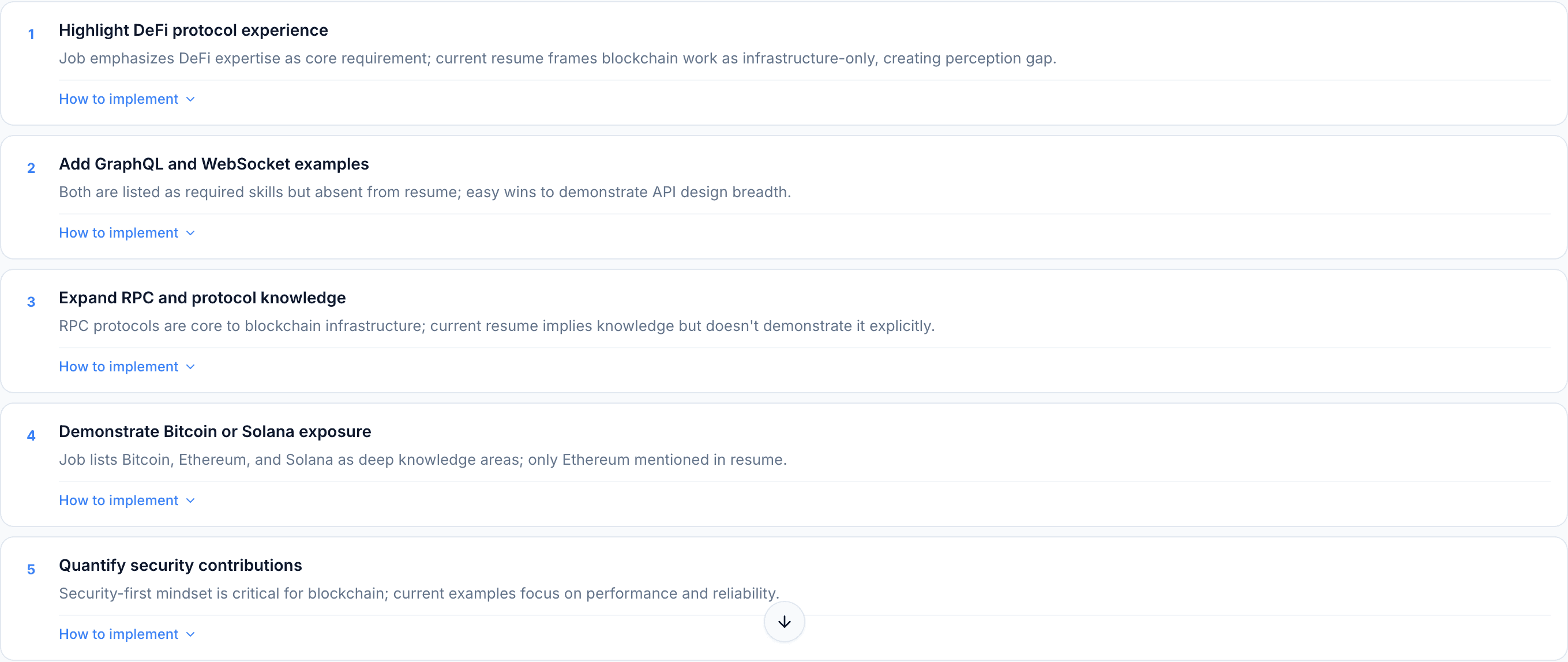 Recommendations for Dmitri focusing on Kraken-specific blockchain protocols and team collaboration
Profile B. Yuki Tanaka, Go/Python platform engineer with strong infrastructure
Yuki is a platform engineer at Booking.com with 5 years of experience building internal developer tooling and shared services in Go and Python. She has strong distributed systems fundamentals and experience with Kafka, Kubernetes, and high-scale event processing, but no production Rust or blockchain experience. Her platform engineering background shows she understands building abstractions that other teams depend on.
 Yuki's fit analysis showing 52% ATS score, 7/12 skills matched, Weak Match
52%. Weak Match. 7/12 skills matched.
 Yuki's technical assessment showing platform engineering strengths but missing core requirements
Yuki's evaluation reveals a candidate with excellent platform engineering fundamentals but significant gaps in the role's core requirements. The assessment acknowledges her strong distributed systems experience and proven ability to build abstractions used by hundreds of services, which directly translates to Kraken's platform team needs. However, the lack of production Rust experience and blockchain protocol knowledge creates substantial learning curves. The evaluator notes that while her Go background provides some systems programming foundation, Rust's ownership model and performance characteristics require dedicated learning time that could delay contributions to a fast-moving team.
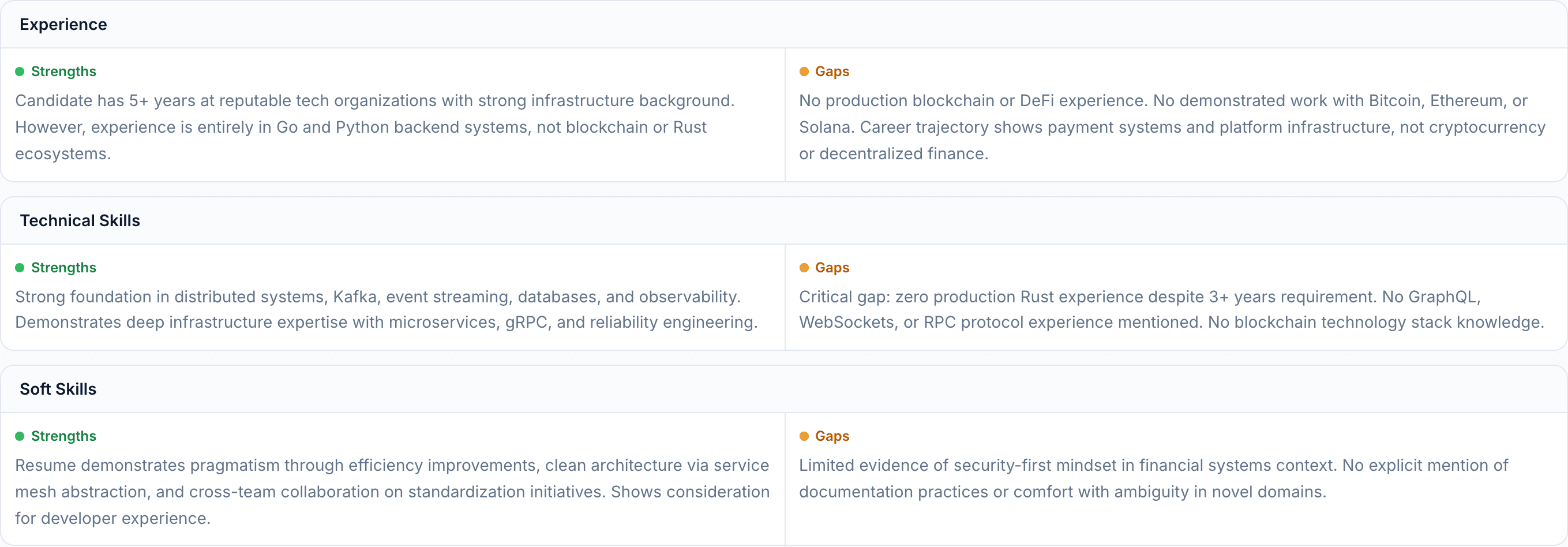 Detailed analysis of Yuki's qualifications highlighting the learning curve for Rust and blockchain protocols
What JobJam recommended
-
Learn Rust fundamentals and build production projects. 3+ years Rust requirement is non-negotiable for this role. Resume shows zero production experience, which is a critical blocker.
-
Gain hands-on blockchain and DeFi experience. Role requires deep blockchain ecosystem knowledge. Current background in payments is adjacent but insufficient for cryptocurrency-specific challenges.
-
Develop RPC and WebSocket protocol expertise. These are core to blockchain infrastructure but absent from current skill set. gRPC experience is transferable but different paradigm.
-
Deepen security-first design practices. Blockchain demands security-first thinking from day one. Resume shows reliability focus but not explicit security architecture experience.
-
Highlight financial systems security experience in cover letter. Payment processing background at Adyen demonstrates relevant security and compliance thinking that transfers to blockchain.
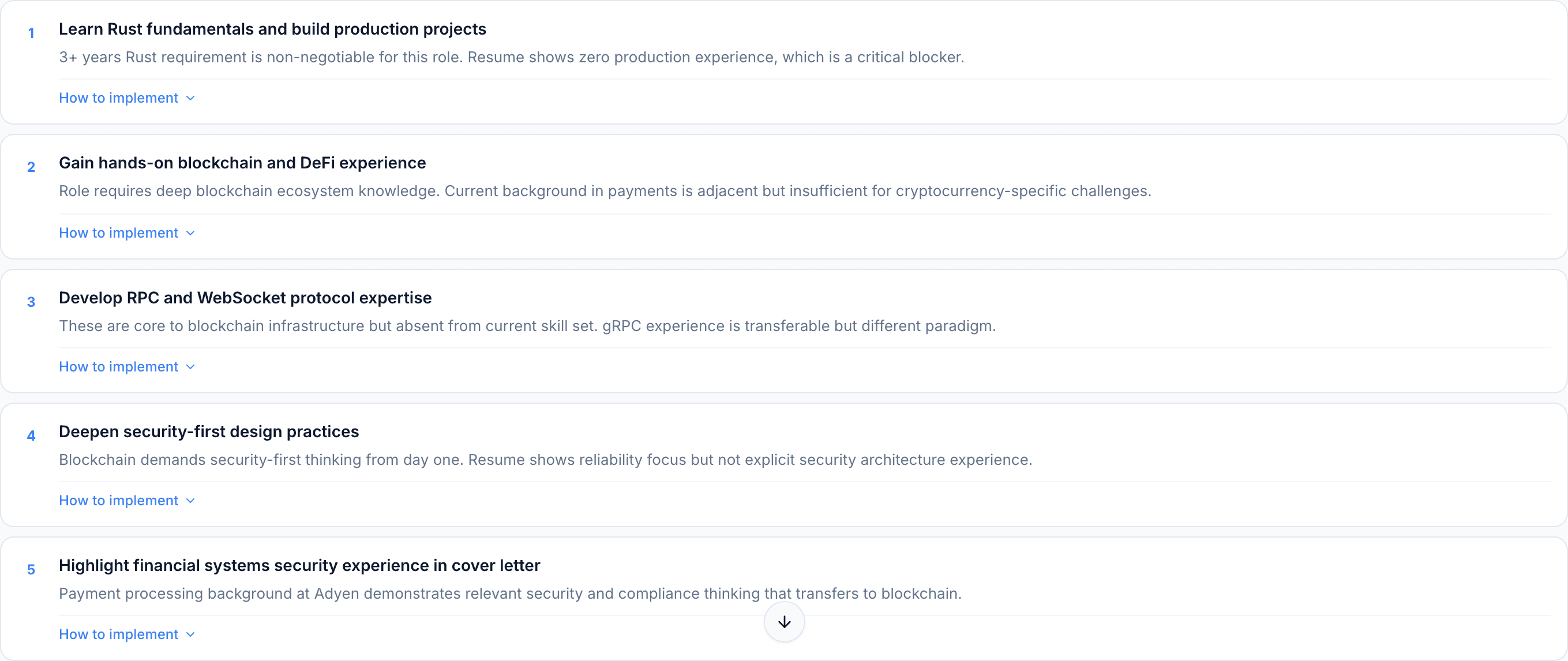 Recommendations for Yuki focusing on building Rust proficiency and blockchain protocol understanding
Profile C. Chioma Osei, TypeScript full-stack developer and crypto enthusiast
Chioma is a full-stack engineer at Flutterwave with 3 years of experience in TypeScript and React. She's passionate about crypto and has done freelance Web3 frontend development, contributing to Ethereum tooling and running her own node. While she has blockchain enthusiasm and some technical exposure, her experience is primarily frontend-focused without the systems engineering depth required for platform infrastructure.
 Chioma's fit analysis showing 28% ATS score, 4/14 skills matched, Weak Match
28%. Weak Match. 4/14 skills matched.
 Chioma's technical assessment highlighting the significant gaps in backend systems and Rust experience
Chioma's evaluation shows a candidate with genuine blockchain passion but insufficient technical depth for a senior systems engineering role. The assessment recognizes her enthusiasm and basic blockchain knowledge from frontend development and node operation, but identifies critical gaps in systems programming, distributed systems design, and production-scale infrastructure experience. Her TypeScript background provides some programming foundation, but the jump to Rust systems programming and handling billions of operations daily represents multiple years of skill development. The evaluator notes that while her blockchain interest is valuable, the role requires deep technical expertise that can't be bridged quickly.
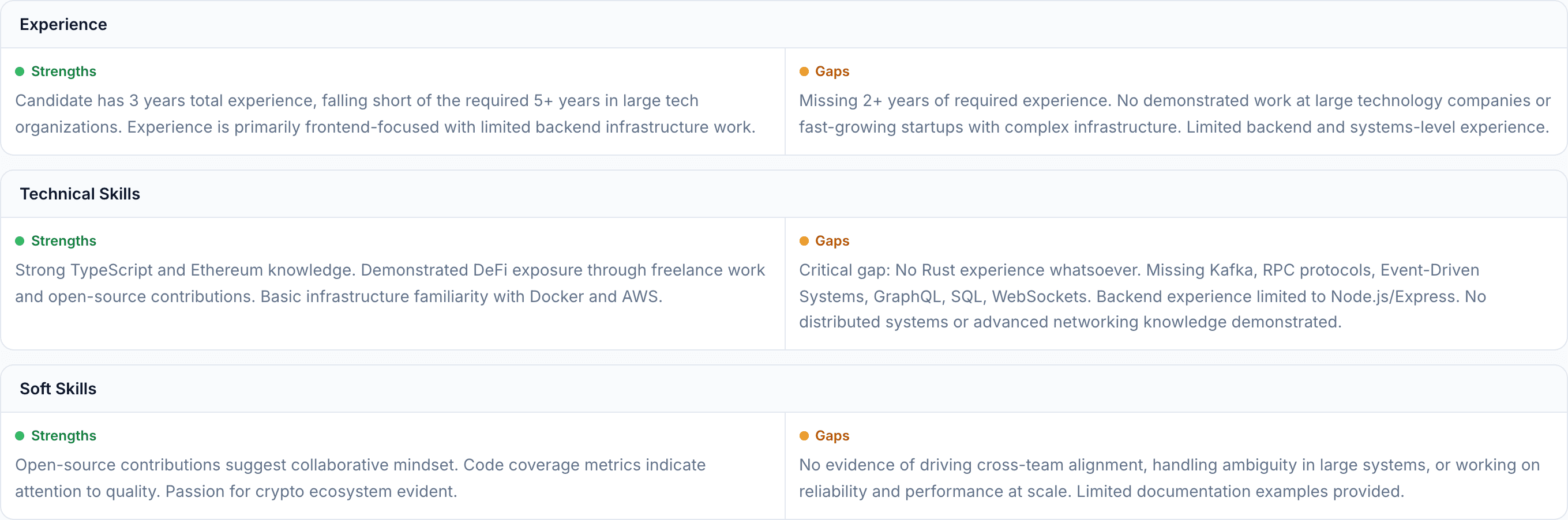 Detailed analysis of Chioma's qualifications showing enthusiasm but insufficient technical depth for the role
What JobJam recommended
-
Learn Rust fundamentals and build projects. Rust is a hard requirement with 3+ years needed. This is the single largest blocker for this senior role.
-
Gain backend infrastructure experience. Role requires autonomous debugging across OS, network, and distributed systems. Current Node.js experience is insufficient.
-
Develop distributed systems knowledge. RPC protocols, Kafka, Event-Driven Systems, and WebSockets are core requirements with zero current experience.
-
Gain experience at larger organization. Role requires 5+ years at large tech companies or fast-growing startups. Current experience is primarily freelance and mid-market.
-
Deepen blockchain infrastructure knowledge. Current experience is DeFi frontend-focused. Senior role requires deep protocol-level understanding across multiple ecosystems.
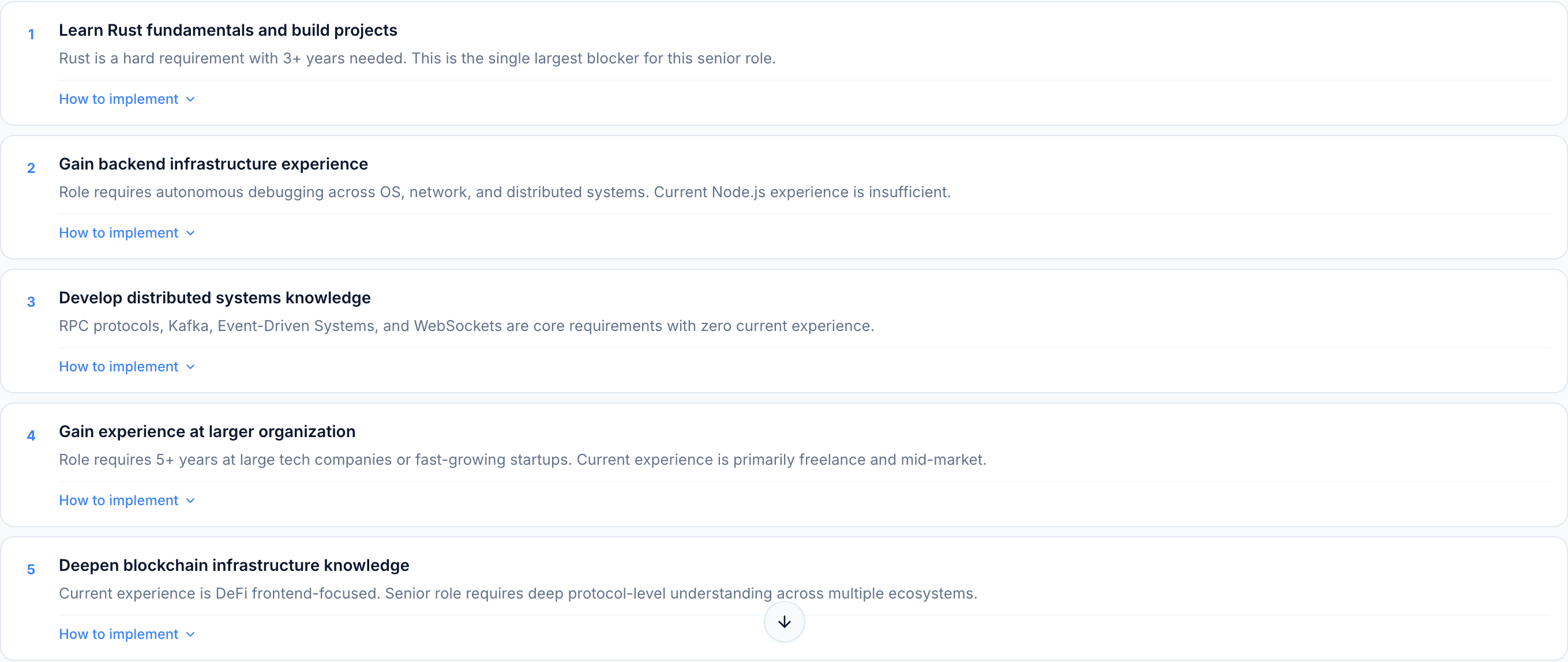 Recommendations for Chioma focusing on building fundamental systems engineering skills
What this shows
The three evaluations reveal how JobJam distinguishes between different types of technical experience for systems-critical roles. Dmitri's high score reflects the direct transferability of HFT systems engineering to blockchain infrastructure. Both require Rust performance optimization, security-first design, and handling financial data at scale. Yuki's moderate score shows that strong platform engineering fundamentals can partially compensate for missing domain expertise, but the Rust and blockchain gaps create substantial learning overhead. Chioma's low score demonstrates that blockchain enthusiasm and frontend experience don't translate to systems engineering capabilities, even with some protocol familiarity.
The analysis consistently emphasizes production experience over theoretical knowledge, recognizing that building reliable infrastructure for financial systems requires having debugged complex distributed systems failures in high-stakes environments.
Not a mockup. Here's the full dashboard
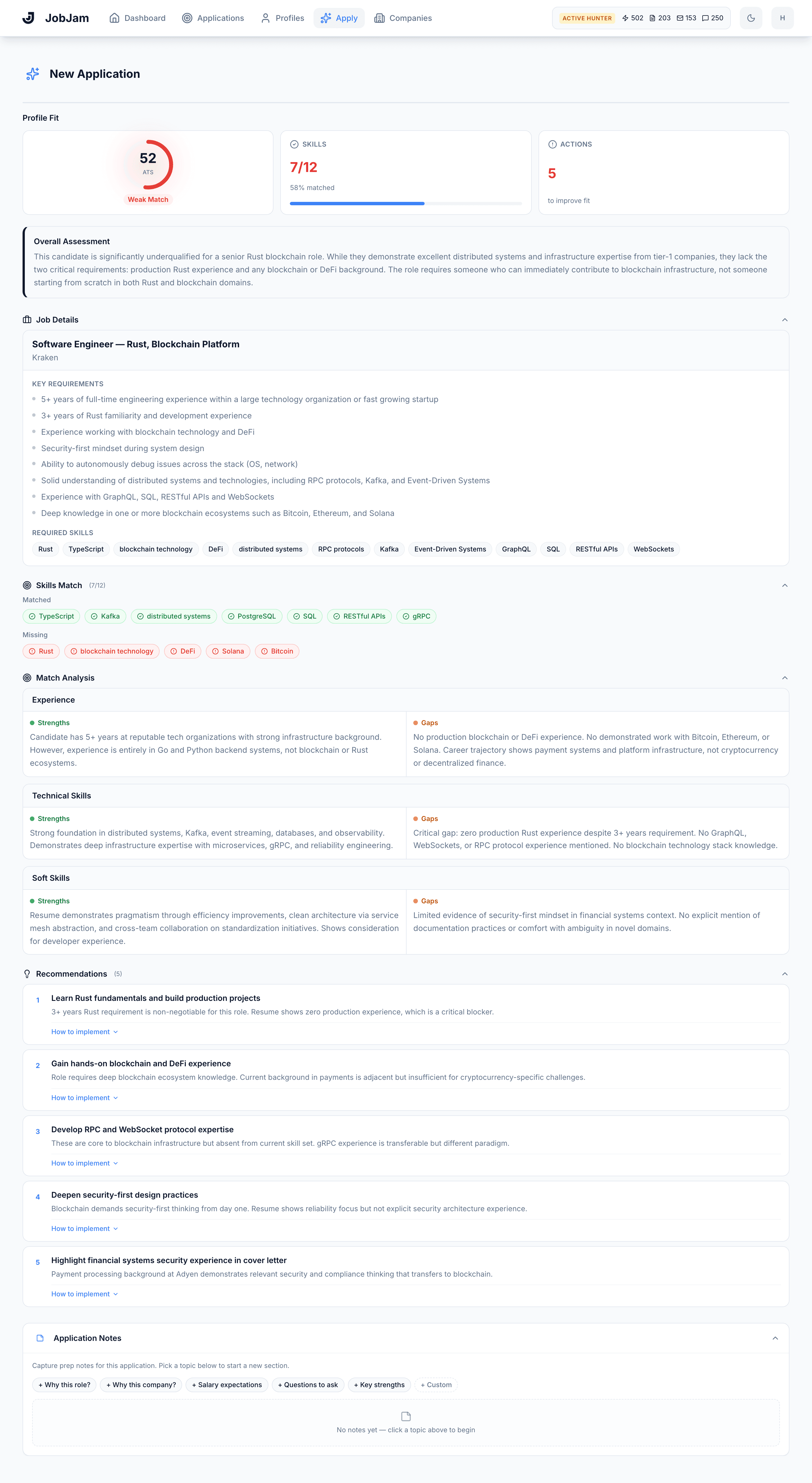 Full JobJam dashboard showing Yuki's complete evaluation with detailed scoring breakdown and analysis
JobJam uses a one-time credit model. No subscription, no auto-renewal. See pricing →