Why Job Seekers Are Replacing Their Spreadsheets with JobJam
Your spreadsheet doesn't know you got rejected
It shows you "Applied, Mar 30, Redcare Pharmacy." It doesn't tell you that your resume was a 62% match for that role, that you were missing three of the eight required skills, or that your summary wasn't written for that type of position. It just shows you a row.
That's the fundamental problem with tracking your job search in a spreadsheet. It records what happened. It can't tell you why.
What you're missing
When a recruiter calls three weeks after you applied, your spreadsheet gives you a company name and a date. JobJam gives you the full job description, the exact resume version you submitted, your fit score at the time, your cover letter, and any notes you added. You're context-loaded in 30 seconds instead of scrambling.
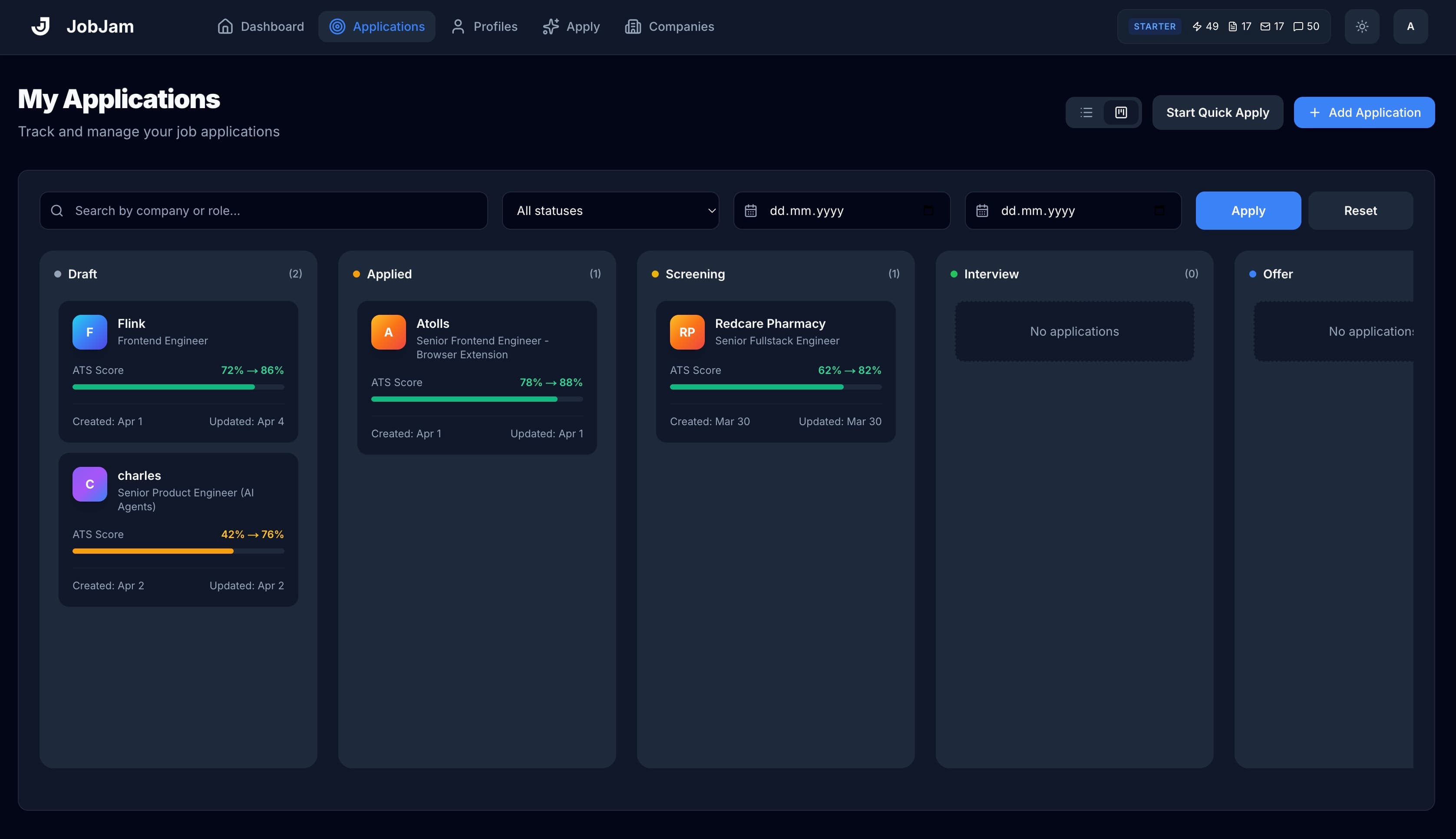 JobJam kanban board showing applications across Draft, Applied, Screening, Interview, and Offer stages
Before you apply, JobJam tells you your ATS score for the role and shows you a breakdown of matched vs missing skills: the kind of signal that tells you whether to apply as-is or spend ten minutes optimizing first.
 JobJam match analysis showing strengths and gaps across Experience, Soft Skills, and Technical Skills
A spreadsheet can't do any of that. It's a list. JobJam is the intelligence layer your job search is missing.
A spreadsheet can't find you roles either
A spreadsheet only holds what you put into it. JobJam also brings roles to you: a built-in job board scans Greenhouse, Lever, and Ashby every 24 hours, so you find openings, score your fit, tailor your resume, and track the application in one place, instead of copying links from ten browser tabs into a sheet.
The switch takes five minutes
Import your existing applications, upload your resume once, and you're set up. Everything you were tracking manually is now tracked automatically, with ATS scores, resume versions, and full application memory attached.
JobJam uses a one-time credit model. No subscription, no auto-renewal. See pricing →